


At a glance
- Phytoestrogens are of plant origin — isoflavones (soy, red clover), lignans (flax), coumestans
- Their estrogenic activity is 10 to 1,000 times weaker than human estradiol
- HRT uses synthetic or animal hormones that directly replace your estrogens
- Phytoestrogens modulate receptors — adaptive effect depending on the tissue (bones, brain, mucous membranes)
- Japanese women consume 25–50 mg/day of isoflavones through traditional diet
- EFSA considers isoflavones safe up to 150 mg/day in healthy menopausal women
Table of Contents
What is a Phytoestrogen?
The term may seem intimidating. However, it's a simple concept: phytoestrogens are compounds found naturally in certain plants that, once ingested, interact with your body's estrogen receptors. "Phyto" comes from Greek and means plant.
What fundamentally distinguishes them from human hormones is their slightly different molecular structure and—above all—their much lower affinity for receptors. In practice, their estrogenic activity is estimated to be between 10 and 1,000 times lower than that of estradiol produced by your ovaries.

The Three Main Families of Phytoestrogens
How Do They Act on Your Receptors?
Your cells have two types of estrogen receptors: ERα (found mainly in the uterus, breast, liver) and ERβ (found in bones, brain, vessels, intestines). Natural estradiol binds strongly to both. Phytoestrogens, however, have a marked preference for ERβ — which explains their different action profile and, according to specialists, their better safety profile in sensitive tissues.
« The selectivity of phytoestrogens for ERβ is at the heart of the scientific debate on their safety. It is precisely this preference that distinguishes them from HRT and guides the majority of current research on menopausal phytotherapy. »
Phytoestrogens vs. Synthetic Hormones: The Fundamental Difference
Confusion between these two categories is common—and understandable. However, two substances that act on the same receptors are not equivalent. Here's why.
HRT: Direct Hormone Replacement
Hormone Replacement Therapy (HRT) — now called Menopausal Hormone Therapy (MHT) in France — consists of administering exogenous hormones to compensate for the hormonal drop associated with menopause. These hormones are either synthetic (ethinylestradiol, medroxyprogesterone acetate) or of animal origin (equine conjugated estrogens). Their mechanism: directly substitute for your failing ovarian production, fully activating both ERα and ERβ receptors.
MHT is effective for severe symptoms. It is also associated with documented risks: according to the Women's Health Initiative study (JAMA, 2002), high doses of synthetic estrogens + progestins slightly increase the risk of breast cancer and cardiovascular events in certain patient profiles.
Phytoestrogens: A Modulating Effect, Not a Substitute
Phytoestrogens do not replace your hormones. They modulate your receptors according to a mechanism called a botanical SERM (selective estrogen receptor modulator of natural origin). Depending on the tissue and the ambient hormonal level, they can exert a slightly activating or slightly blocking effect—an adaptive behavior that synthetic hormones do not reproduce.
The European Food Safety Authority concluded that soy isoflavones at doses up to 150 mg/day do not pose a risk to bone, thyroid, or endometrial health in healthy menopausal women.
What Science Says About Isoflavones and Menopause
Soy and red clover isoflavones are the most documented phytoestrogens in the context of menopause. Several decades of research now allow for a nuanced assessment.

Hot Flashes: Key Studies
A Cochrane review of 43 randomized clinical trials (Lethaby et al., 2013) concluded that isoflavones reduce the frequency of hot flashes by approximately 17% compared to placebo, with a reduction in their intensity also observed. The effect is modest but reproducible—and particularly noticeable in women experiencing more than 5 hot flashes per day.
A meta-analysis published in Menopause (2012) of 19 studies confirmed this trend, noting that the effectiveness of isoflavones is dose-dependent and individual: some women are "active metabolizers" of equol (a daidzein metabolite) who benefit more from isoflavones than others.
The Japanese Population: A Natural Observational Example
Traditional Japanese women consume between 25 and 50 mg of isoflavones daily through tofu, miso, and edamame. Their prevalence of severe hot flashes during menopause is historically lower than that of Western women—an observational (not causal) finding that has fueled scientific interest in these molecules since the 1990s.
🦴 Bone Density
Several studies show that isoflavones help maintain bone mineral density after menopause, through their action on ERβ receptors of osteoblasts (bone-forming cells).
💧 Vaginal Dryness
Oral supplementation studies show an improvement in vaginal mucous membranes, with a beneficial effect on mild to moderate urogenital atrophy.
❤️ Cardiovascular Health
An EFSA review (2015) notes a tendency for improvement in lipid profile (LDL, HDL) with regular isoflavone supplementation, without adverse effects on blood pressure.
🧠 Mood and Cognition
Exploratory studies suggest a beneficial effect on mood and verbal memory during perimenopause, via brain ERβ receptors. Data remain preliminary but promising.
Soy Isoflavones and Red Clover in Menopause Vitality Complex
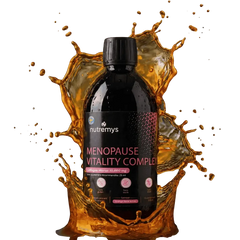
The Nutremys Menopause Vitality Complex contains two plant phytoestrogens among its 14 clinically dosed active ingredients:
- Soy isoflavones — 2 mg per daily dose
- Red clover extract (Trifolium pratense) — 2 mg per daily dose
These doses are part of a strategy for gentle and synergistic supplementation — they are not designed to replicate HRT, but to support the natural hormonal balance of the menopausal transition as part of a comprehensive formula.
"Hormone-free" ≠ "phytoestrogen-free"
On the Menopause Vitality Complex packaging, you read: "hormone-free". This claim is precise and sincere: the formula contains no synthetic estrogens (ethinylestradiol, conjugated equine estrogens) or synthetic progestins. However, it does contain plant-derived phytoestrogens — and we fully embrace this.
Soy isoflavones and red clover extract are plant-based ingredients whose benefits are scientifically documented. Including them in our formula is a deliberate and accepted choice—not an ambiguity to hide. "Hormone-free" and "contains natural phytoestrogens" are two complementary realities, not contradictory ones.

Why these ingredients at a complementary dose?
At 2 mg each, these phytoestrogens are part of a different approach from high-dose isoflavone supplementation (typically 40–80 mg in clinical studies). The goal is to activate ERβ receptors in synergy with the other active ingredients in the formula: marine collagen, vitamin D3, magnesium bisglycinate, zinc, and B complex. This is the holistic approach that characterizes the Nutremys philosophy: no "isolated miracle pill," but a formula where each active ingredient reinforces the others.
Precautions: Who Should Be Vigilant with Phytoestrogens?
Phytoestrogens are well tolerated by the vast majority of women. However, there are situations where medical vigilance is necessary before any supplementation.
| Situation | Level of Vigilance | Recommendation |
|---|---|---|
| Healthy menopausal woman | ✅ Low | No contraindication to standard complementary doses |
| History of hormone-dependent cancer (breast, endometrium) | ⚠️ High | Mandatory medical consultation before any isoflavone supplementation |
| Hypothyroidism treated with levothyroxine | ⚠️ Moderate | Take medication 2–3 hours before or after supplement containing isoflavones |
| Confirmed soy allergy | ⚠️ High | Avoid soy isoflavone supplements; consult before use |
| Pregnancy or breastfeeding | ⛔ Contraindication | Phytoestrogen supplements not recommended as a precaution |
Hormone-Dependent Cancer: Expert Position
The position of the European Menopause and Andropause Society (EMAS) and EFSA is now nuanced: there is no evidence that isoflavones at dietary or standard complementary doses increase the risk of breast cancer in the general population. Asian populations with high soy consumption even show historically lower rates of breast cancer than Western populations — although causality has not been established. However, in the event of a personal or family history of hormone-dependent cancer, medical consultation remains imperative.
Hypothyroidism and Soy Isoflavones
Soy isoflavones can reduce the intestinal absorption of levothyroxine sodium (Levothyrox®, Euthyrox®). If you are undergoing thyroid treatment, it is sufficient to observe an interval of 2 to 3 hours between your medication and your supplement containing isoflavones. This simple precaution is sufficient in the vast majority of cases.
This article is for informational purposes only and does not replace personalized medical advice. If you have any doubts about your health, consult your doctor or gynecologist before starting any supplementation.
Frequently asked questions about phytoestrogens
Scientific sources
- Lethaby A. et al. — Phytoestrogens for menopausal vasomotor symptoms, Cochrane Database Syst Rev, 2013 — Cochrane Library
- EFSA Panel on Food Additives and Nutrient Sources — Risk assessment for peri- and post-menopausal women taking food supplements containing isolated isoflavones, EFSA Journal, 2015 — efsa.europa.eu
- Writing Group for the WHI Investigators — Risks and Benefits of Estrogen Plus Progestin in Healthy Postmenopausal Women, JAMA, 2002 — PubMed
- Messina M. — Soy and Health Update: Evaluation of the Clinical and Epidemiologic Literature, Nutrients, 2016 — PubMed
- Williamson-Hughes P.S. et al. — Isoflavone supplements containing predominantly genistein reduce hot flash symptoms, Menopause, 2006
- Usui T. — Pharmaceutical prospects of phytoestrogens, Endocrine Journal, 2006
Formulated with care. Transparent by conviction.
The Menopause Vitality Complex combines 14 clinically dosed active ingredients — including natural isoflavones, marine collagen, and vitamin D3 — to support your menopause with integrity.
Discover the full formulaThe information shared on this blog is for educational and informational purposes only. It does not replace medical consultation, diagnosis or treatment prescribed by a healthcare professional. If you have symptoms, are undergoing treatment or are pregnant, consult your doctor before modifying your diet or starting supplementation. Nutremys LAB food supplements should not replace a varied, balanced diet or a healthy lifestyle.
